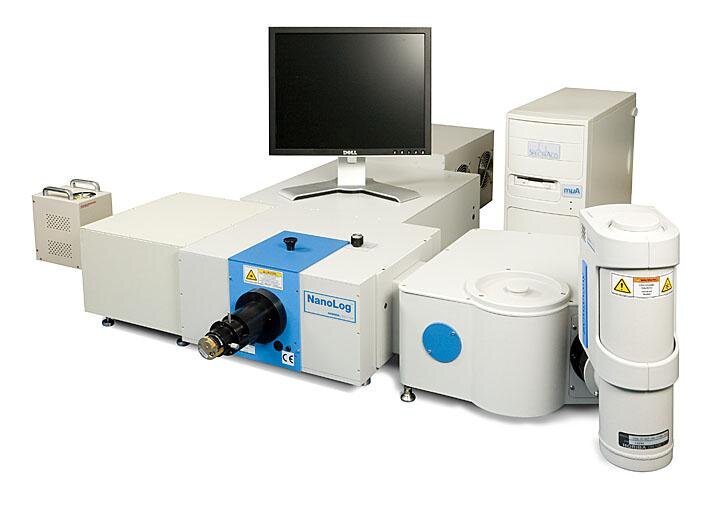
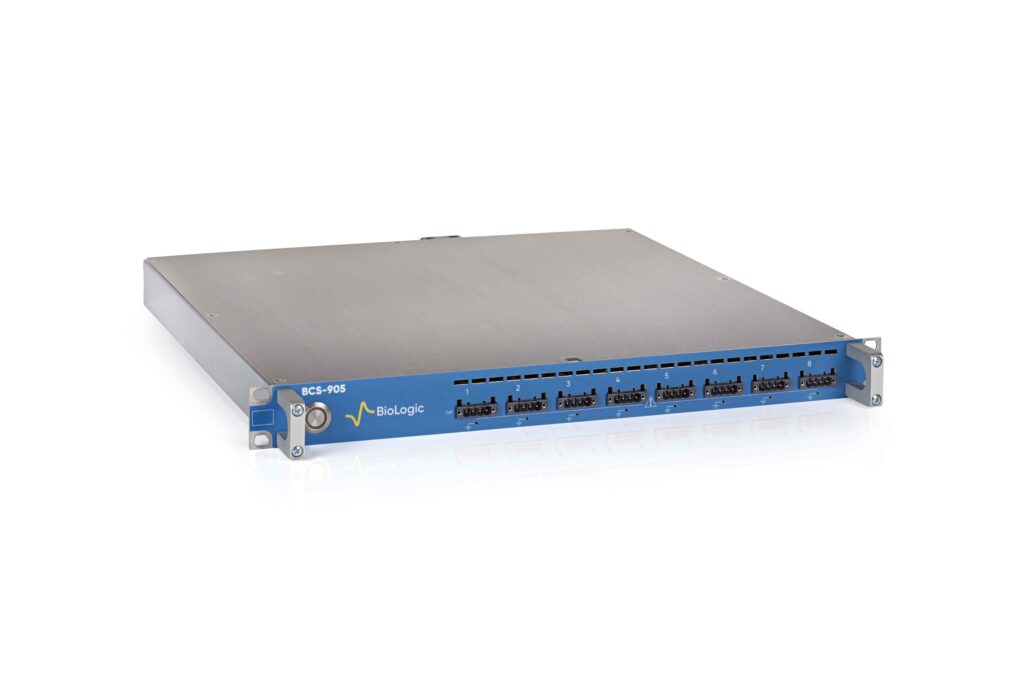
The HORIBA Nanolog is a near-infrared fluorescence spectrometer specifically designed for NIR-emitting nanomaterials including single-wall carbon nanotubes (SWCNTs), NIR quantum dots, and rare-earth upconversion nanoparticles.
The HORIBA Nanolog is a specialized fluorescence spectrometer engineered for near-infrared (NIR) photoluminescence characterization of nanomaterials, particularly single-wall carbon nanotubes (SWCNTs), NIR quantum dots (PbS, InAs, CdTe), rare-earth doped nanoparticles, and other NIR-emitting nanostructures. The system combines a double-grating excitation monochromator with a high-sensitivity liquid nitrogen cooled InGaAs array detector, providing 2D excitation-emission (PLE) mapping capability across the NIR spectral region from approximately 850 nm to 1700 nm. This full-PLE mapping in the NIR range is uniquely powerful for carbon nanotube characterization: each SWCNT chirality has a distinct (n,m) assignment with characteristic excitation and emission peaks, and the 2D map allows simultaneous identification and quantification of multiple SWCNT species in a mixture. The Nanolog enables PLE map acquisition in minutes rather than hours, thanks to its InGaAs array detection (simultaneous multi-wavelength detection). It is also used for characterizing NIR quantum dot size distribution, heavy-metal-free quantum dot alternatives, and upconversion nanoparticle emission properties. NewRoad provides the HORIBA Nanolog in Israel for nanotechnology, nanomedicine, and photovoltaics research groups working with NIR-emitting nanostructures.
WHY CHOOSE THIS PRODUCT
2D excitation-emission (PLE) mapping in the NIR for SWCNT chirality assignment
Liquid-nitrogen-cooled InGaAs array for maximum NIR sensitivity (850-1700 nm)
Rapid PLE map acquisition vs. point-by-point scanning alternatives
Ideal for NIR quantum dots, carbon nanotubes, and rare-earth upconversion materials
Quantitative analysis of SWCNT chirality populations in mixed samples
Surface science and nanoscale measurement instruments support life science researchers in studying biomolecular interactions, cell adhesion, and membrane behavior with high precision.
Spectroscopy
Chemistry & Biochemistry
Versatile analytical and surface characterization instruments support fundamental and applied research in molecular chemistry, reaction kinetics, colloid science, and biomolecular analysis.
Measurement & Sensing
Food & Beverage
Analytical and surface measurement instruments support food and beverage manufacturers in ensuring product quality, stability, and compliance at every stage of production.
Spectroscopy
Pharmaceutical
Pharmaceutical R&D and manufacturing rely on surface analysis, compound characterization, and real-time interface monitoring to develop safe, effective, and consistently produced drug products.
RELATED PRODUCTS
Explore Similar Solutions
Browse related instruments and complementary solutions selected for your research and application.